
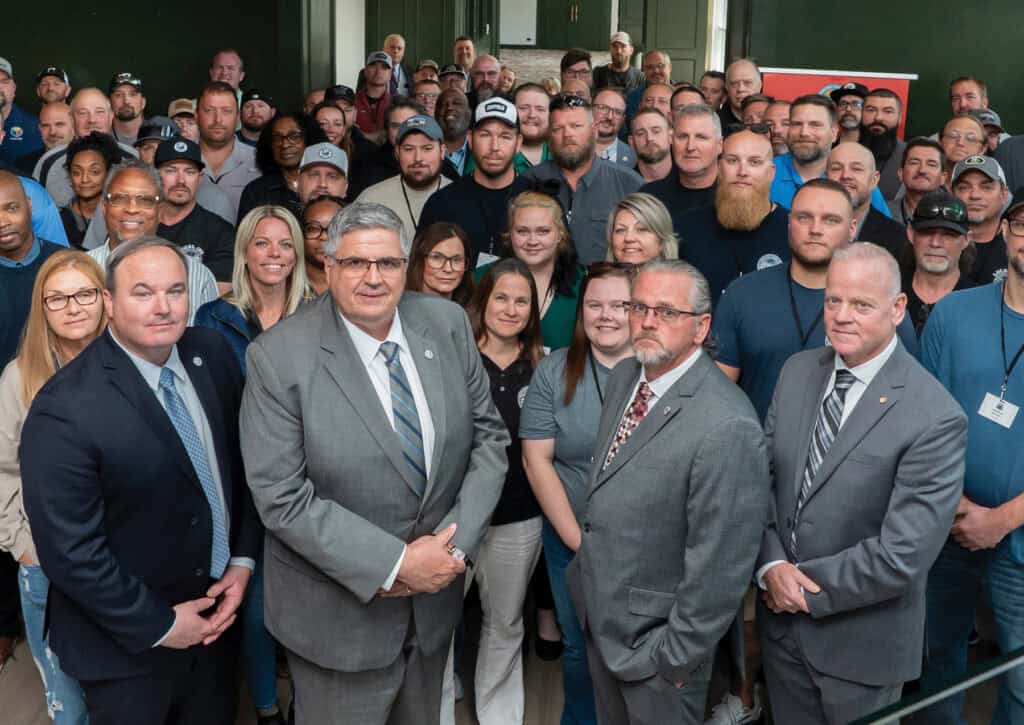
 As 2026 draws to a close, we have much to be proud of and look forward to in 2027 and beyond. This year, more than 550 UWUA members gathered at regional conferences across the country. We welcomed first-time participants, reconnected with longtime leaders and heard about the challenges facing our locals.
Members came ready to learn, share experiences and strengthen connections. People from different industries and regions discovered they were confronting many of the same issues.
We also took the opportunity at the four regional conferences to ask local union officers and members: How can your national union better support you?
The response was clear. Members want practical training that gives them the confidence to represent coworkers, manage their locals, negotiate strong contracts and meet increasingly complex challenges.
We heard you. And we are acting on that feedback.
Investing in our leaders
The UWUA is expanding its leadership education offerings, emphasizing training delivered in small group settings. We want instruction tailored to each local’s needs and the experience levels of its officers and stewards.
The challenges facing a newly elected steward differ from those confronting a longtime president. Locals also differ in how they administer contracts, investigate grievances and conduct daily business.
We’ve asked Jim Harrison, our National Director of Renewable Energies, to lead these training initiatives. He is developing materials and working with national representatives to deliver this training. The effort includes a handbook in development for local union officers, covering governance, financial responsibilities, member representation and effective meetings.
Our expanded training offerings include steward and new officer training, local union administration, contract bargaining basics, and understanding artificial intelligence and how to bargain over its use.
Stewards and newly elected officers need a foundation in contract interpretation, grievance investigation and responsibilities as representatives. Local leaders also need guidance on the administrative work that keeps a union functioning effectively.
Collective bargaining training will cover bargaining rights, labor law fundamentals and negotiating strategies. Artificial intelligence training will address how employers are introducing new technology and the protections workers should seek through bargaining.
We are also investing in True Colors Leadership, an interactive program that helps participants understand different leadership and communication styles. The UWUA has trained and certified five facilitators to deliver the program, which can be tailored to individual locals.
A leader may know every provision of a contract and still struggle to communicate with a frustrated member or build consensus around a difficult decision. Understanding how people approach problems makes us better representatives and stronger teams.
Providing consistent, useful training across the country is an essential investment in our union’s future.
Leadership is more than a title
Our regional conferences reinforced another lesson: Effective leadership begins with how we treat people.
Throughout this year’s conferences, we emphasized that local officers and stewards are the face of the UWUA to the members they serve. For many workers, their understanding of the union comes from the person who answers a question, investigates a grievance or listens when something goes wrong.
Those interactions matter. An issue that seems routine to an experienced representative may be the most important workplace problem a member has ever faced.
We also reminded conference participants that attending a union training carries a responsibility. Their fellow members are working while they attend, and members’ dues make those opportunities possible. They deserve a return on that investment.
That return comes when participants bring new knowledge home, share it with their leadership teams and put it to work.
The leadership presentations challenged us to think about trust, teamwork, communication and commitment. These qualities determine whether members feel comfortable raising concerns, whether new activists step forward and whether a local can act together when it matters most.
We need experienced leaders willing to share their knowledge and prepare others to step into leadership roles, and newer members willing to ask questions, offer fresh perspectives and accept responsibility.
The future of the UWUA depends on developing people, not simply filling positions.
Growing our strength through organizing
Leadership development is closely connected to another national priority: organizing.
Under Organizing Director Deirdre Brill, and with the addition of UWUA members J.J. Popio and Melissa Harter as full-time organizers, we have expanded our ability to respond to workers seeking representation.
That investment is producing results.
In February, workers at an Enbridge Gas liquefied natural gas storage facility in Magna, Utah, voted to join the UWUA, marking our first organizing victory in the state. The campaign demonstrated what determined workers can accomplish with national organizing support.
The workers are pursuing their first contract with assistance from Senior National Representative Valerie King, National Organizer J.J. Popio and Local G-555, which represents Enbridge employees in Ohio.
This victory establishes a UWUA presence in a new state and opens opportunities to organize other utility workers in the region.
It also demonstrates an important principle: Organizing is not finished when workers vote for representation. They need strong contracts, effective leadership and a union that makes them feel welcome and involved.
We encourage locals to recognize opportunities within their workplaces. Unrepresented employees may be working alongside our members who would benefit from a collective voice. Local leaders are often best positioned to identify those opportunities.
Our national organizing department is there to help, and we have taken steps to reduce some of the financial risks locals face when pursuing campaigns.
Growing our union takes commitment, resources and persistence. Every new member strengthens our collective voice, but every successful campaign begins with someone recognizing an opportunity and deciding to act.
Preparing for a changing industry
Strong leadership extends beyond our union halls.
Utility workers are at the center of discussions about energy affordability, reliability, infrastructure investment and economic growth.
Electric demand is rising, driven partly by data centers and other large energy users. Communities need grid upgrades, dependable natural gas infrastructure and safe water and wastewater systems. Meanwhile, customers are concerned about rising bills, and policymakers are debating how to meet future demand.
These decisions will affect our members for years to come.
We cannot sit on the sidelines while others determine how utility systems will be built, operated and maintained — or who will perform that work.
Our members understand what it takes to restore power after a storm, maintain gas infrastructure, operate generating facilities and deliver safe water. That expertise must be part of the discussion.
We should ask whether proposed investments will provide reliable service, protect customers from unreasonable costs, create good union jobs and ensure utilities have the skilled workforce to operate safely. Through our work with the AFL-CIO, we are helping develop policies to ensure large data centers pay their fair share of infrastructure costs rather than shifting expenses onto residential customers.
Artificial intelligence presents another challenge. Employers are exploring its use in operations, administration and workforce management. Some applications may be useful, but new technology raises questions about job security, worker privacy, surveillance and safety.
Ignoring these developments will not stop them. Our responsibility is to understand them, engage early and negotiate protections that put workers’ interests first.
Local leaders must remain engaged with lawmakers, regulators and their communities, working with the National union to ensure utility workers have a meaningful voice.
We are not simply preparing to react to the future. We intend to help shape it.
Together we build a better tomorrow
That commitment brings us to 2027 and our upcoming national convention.
Our convention theme, Together We Build a Better Tomorrow, reflects our progress and the work ahead.
No national officer, staff representative or local leader can build a strong union alone. Our strength comes from members who step forward, share what they know, support one another and take collective action.
We must continue developing leaders, strengthening locals, organizing new workers and adapting to changes in the industries we represent.
As we move toward the convention, tell us what training your local needs. Share the challenges you are encountering and the approaches that are working.
We encourage local officers and stewards to take advantage of the expanding training opportunities. Contact your staff representative to discuss what would be most useful for your local, whether in person or virtually.
And we ask every member to consider how you can contribute. You do not need to hold an office to make a difference. You can welcome a new coworker, participate in a union activity, raise a safety concern, mentor a younger worker or encourage someone to become more involved.
As we close another year, we thank our members, local officers, stewards, committee members and staff for the work you do on behalf of this union and the communities you serve.
The challenges ahead are significant. So are the opportunities.
With stronger leaders, more engaged members and a shared commitment to the future, we have every reason to move forward with confidence.
Soon, we will gather in Chicago to chart our union’s future and celebrate our accomplishments. Until then, we will continue working hard on your behalf into 2027 and beyond, because together, we build a better tomorrow.
———————
photo caption- Front row, from left: Vice President Craig Pinkham, President James Slevin, Executive Vice President Patrick Dillon and Secretary-Treasurer Michael Coleman.