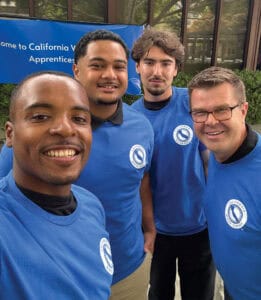
A year ago, the California Water Utility Council’s plans for a first-of-its-kind water utility apprenticeship were still largely a vision. Today, three young workers are on the job, beginning a 17-month journey toward careers as skilled union water utility workers.
And they had plenty of competition to get there. 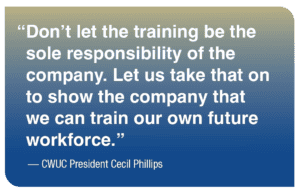
About 500 people applied for just three openings in the new Cal Water Apprenticeship Program — a partnership among the California Water Utility Council (CWUC), California Water Service (Cal Water) and UWUA’s Power for America (P4A) Training Trust. The overwhelming response offers compelling evidence that good union utility careers remain attractive to a new generation of workers.
CWUC President Cecil Phillips sees another message in those numbers. Even in California’s technology-driven Bay Area, he said, hundreds of people recognized the value and opportunity of a career in water.
“There are people out there who are eager to join our workforce,” Phillips said. Despite technological advances, “we’re going to need people to operate our water systems.”
The apprenticeship grew out of a problem familiar throughout the utility industry: how to bring new workers into increasingly skilled jobs as experienced employees retire. In the Bay Area, Cal Water faced an additional challenge. The company could hire workers, but retaining them in a high-cost region was difficult. The partners began exploring an apprenticeship as far back as 2018, envisioning a program that could recruit people from the communities Cal Water serves, give them a structured path into the industry and offer opportunities for long-term career growth.
It took years to turn that idea into reality. P4A, the union and Cal Water had to develop curriculum, determine the right sequence and length of classes, find a community college partner and work through regulatory and hiring constraints. P4A Executive Director Jonathan Harmon describes the process as sometimes “two steps forward, one step back.” But the partners kept working.
Now the payoff is beginning.
The three apprentices are being paid while they learn, combining classroom education with P4A instruction, safety training and extensive hands-on experience. By the end of the program, they are expected to hold California D2 water distribution and T2 water treatment licenses — credentials that can provide the foundation for long careers in the industry.
Just as important, they are learning directly from experienced union members.
Each apprentice has a journeyman mentor selected with union input. They spend their days at job sites, observing, participating and gaining hands-on experience under the guidance of UWUA members who know the work. The three entered the program with no water operating experience, giving the union an opportunity to help develop them “from ground zero,” Phillips said.
Phillips believes that foundation will pay dividends years from now. These apprentices are being trained by members with 15 years or more of experience. In time, they can pass that knowledge to the union members who follow them.
“It strengthens our union’s representation of us training our own members,” he said, while Cal Water benefits from a well-rounded training program and a workforce prepared for the future.
That support extends beyond the formal apprenticeship. P4A Safety Advocate Ben Filippone, whose territory includes the three apprentices, contacted them immediately after their kickoff, met with them and made sure they understood that he was another resource available to them.
That connection illustrates how CWUC’s two major P4A initiatives are beginning to reinforce one another.
Safety innovation takes root
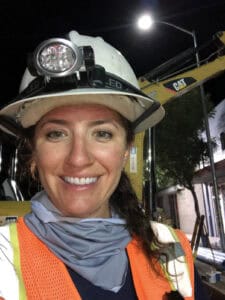
The apprenticeship is the latest example of Cal Water, CWUC and P4A working together to find solutions tailored to the company’s workforce needs. That same collaborative approach has already changed how Cal Water addresses safety.
CWUC and Cal Water launched the P4A Safety Advocate Program in 2019, creating three full-time union safety advocate positions covering districts throughout the state. Written into the collective bargaining agreement, the program provides peer-to-peer education, field audits and targeted training while giving union members a formal voice in identifying and addressing workplace hazards.
From the beginning, the idea was deliberately different from a traditional top-down safety program. Advocates were there to educate and prevent injuries, not discipline workers.
That distinction took time to establish. Harmon says that early on, some employees viewed the advocates as “safety cops.” Today, local management and safety teams increasingly view them as partners and seek their input on emerging issues and training needs.
Phillips sees perhaps the clearest evidence of the program’s success in how unremarkable that involvement has become.
“It’s just part of our normal checklist,” he said. When Cal Water has a major job coming up, a safety advocate can be brought in from the earliest stages. “It’s normal now to have our advocates a part of our work culture.” 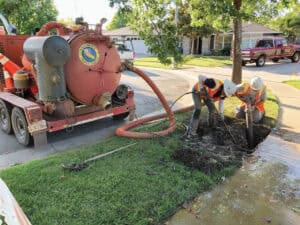
The program has produced tangible results. Safety advocates conduct unannounced field audits, participate in safety committee meetings and develop training based on what they observe. One example was a traffic-control module developed after advocates identified a training gap among leak truck foremen. Follow-up audits showed workers adhering to the new standards. Earlier reporting also found declining incident rates and stronger communication between field crews and management.
Interest in becoming an advocate has grown, too. Harmon says applicants now arrive with greater knowledge of safety issues and, increasingly, a genuine passion for the work. Selection is made jointly by union and management and must be unanimous.
A model with room to grow
Neither program is finished.
Three safety advocates cover an enormous state, and Harmon would like to see their ranks grow. The apprenticeship, meanwhile, was launched in the Bay Area, but Phillips, Harmon, and management see potential to expand it throughout Cal Water’s California operations. That could mean partnerships with community colleges in other regions and eventually multiple groups of apprentices moving through the program simultaneously. P4A and Cal Water have also submitted paperwork seeking state apprenticeship recognition. Harmon says he would like to see 20 apprentices in the pipeline within two years. Phillips said he believes the model ultimately has potential “up and down the state, from Northern California to Southern California.”
For other UWUA locals, California’s experience offers a lesson larger than either apprenticeship or safety.
Innovation does not necessarily mean artificial intelligence, new technology or new equipment. Sometimes it means looking at longstanding challenges — recruiting workers, transferring knowledge and preventing injuries — and finding a better way to address them.
“We can adapt with all the technology changes, but at the end of the day, our union members provide a service to our communities that AI or technology can’t,” Phillips said. Building the workforce of the future, he added, starts by teaching future members both safe work habits and the skills required to perform UWUA jobs.
Neither of these programs existed when CWUC, Cal Water and P4A began working together in 2018. Creating them required persistence, compromise and a willingness by labor and management to try something new.
Harmon calls that an important lesson for other locals: “Creating a new program is tough, but it’s achievable.”
Phillips’ message is equally direct. He encourages other UWUA locals to look for opportunities to partner with their employers — but also to insist that the union have a meaningful role in developing the next generation.
“Don’t let the training be the sole responsibility of the company,” he said. “Let us take that on to show the company that we can train our own future workforce.”
That may ultimately be the most important innovation underway at Cal Water. The union is not simply reacting to workforce challenges as they arrive. It is helping determine how workers enter the industry, how they are trained, how they learn to work safely and how generations of knowledge are passed from one UWUA member to the next.
In California, the utility workforce of the future is no longer an abstract idea. UWUA members are helping build it themselves.