UWUA Local 601 members in New Jersey have secured two new collective bargaining agreements — one at the Bordentown Sewerage Authority and another at Veolia Water in Bayonne — delivering meaningful gains while strengthening protections for workers who keep critical water and wastewater systems running.
“Whether they’re operating a municipal wastewater facility in Bordentown or maintaining water and sewer infrastructure in Bayonne, our members are performing essential work that communities rely on every day,” said Local 601 President Noel Christmas. “These agreements reflect the value of that work and show what can be achieved through strong member engagement and unity at the bargaining table. They position our members for continued stability and growth in the years ahead.”
Bordentown builds on strong first contract
At the Bordentown Sewerage Authority, nine Local 601 members ratified their second contract on February 13, building on the foundation established in their first agreement in 2022.
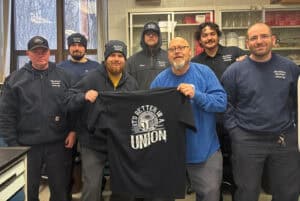
The three-year agreement follows a relatively swift round of negotiations that began in early January and were led by steward Stephen Muller and Local 601 President Noel Christmas with support from Senior National Representative Valerie King. Members voted unanimously to approve the contract, reflecting strong support across the unit.
“These negotiations went smoothly because both sides were focused on reaching a fair agreement,” Muller said. “Management maintained a positive and cooperative attitude throughout the process, and that made a real difference.”
These workers operate the town’s wastewater treatment plant and sewer system, maintaining the facility, its grounds, and 14 pump stations that support the surrounding community.
The new agreement delivers steady wage growth over the life of the contract, totaling 18.5%. For many members, it represents the most significant increase they have seen in years — some with two decades of service noted they had never experienced gains of this magnitude.
In addition, members secured a $1,500 annual medical stipend to help offset rising health care costs — a new benefit and a first for the unit. The stipend will increase annually in tandem with rising health care premiums, helping members stay ahead of those costs. This gain is especially meaningful given that health benefits are set at the state level and outside the scope of bargaining.
The contract also increases pay differentials for licensed operators, raising the hourly premium from $0.60 to $1.00 per license. This change recognizes the value of specialized skills and certifications that are essential to maintaining safe and compliant operations.
For Muller, who has worked at the plant for a decade, the agreement reflects both the progress the unit has made and the importance of staying organized and engaged in the bargaining process.
“We’ve come a long way since that first contract,” Muller said. “This agreement really shows what we can accomplish when everyone stays involved and works together.”
Bayonne unit secures gains at Veolia Water

In Bayonne, eight Local 601 members working for Veolia Water ratified a new three-year agreement in April, following the expiration of their previous contract in March.
The unit, led in negotiations by Local 601 President Noel Christmas, steward Frank Flynn and Senior National Representative Valerie King, performs a wide range of field work across both water and wastewater systems. Crews handle everything from water main repairs and hydrant installations to sewer maintenance, pump station operations, and stormwater system upkeep.
According to Flynn, the negotiations proceeded smoothly, with both sides maintaining an open and productive dialogue throughout the process.
“We were able to get through it pretty seamlessly,” he said.
The agreement includes steady wage increases over the life of the contract, along with targeted improvements tied to job responsibilities and certifications. Notably, the contract increases the hourly premium for workers holding commercial driver’s licenses (CDLs) from $1.50 to $2.75. This change will impact roughly half of the unit.
Additional gains were made in licensing pay and other areas that support workforce development and retention.
While wages were a key priority for members, Flynn noted that the unit also benefits from strong working conditions and a collaborative relationship with management, allowing negotiations to focus on building on an already solid foundation.