

 Meter reading is one of the utility industry’s most essential — and most rapidly evolving — jobs. Across gas, water, and electricity, meter readers are the eyes and ears of the system. They ensure customers are billed accurately and are often the first to spot problems. The work demands precision, independence, and stamina, and it’s changing fast as technology reshapes what the job looks like day to day.
In this installment of How It’s Done, three UWUA members share what the work is like. Loretta Bullet of Local 419 covers gas meters across western Maryland for Columbia Gas. Jay Darden of Local 160-D walks the neighborhoods of Cal Water’s Chico District. And Sara Gardner of Local 310 troubleshoots electric meters throughout Rhode Island for PPL. Together, their stories show a craft in transition — and the skilled hands keeping it running.
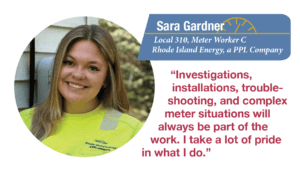 As a field technician, I’m responsible for everything an electric meter might need, from investigations and exchanges to installations and troubleshooting. I started in June 2021 at age 19. What began as a temp position doing collections and shutoffs quickly turned into a permanent role within a month, and I moved into my current position about three months later.
My shift runs from 7:30 AM to 3:30 PM, Monday through Friday. Every day is a little different. I work all over the state — one day I might be in Providence, the next on the opposite end of Rhode Island. On busy days, I handle upwards of 20 service calls on my own. On larger jobs, like replacing meters in an apartment complex, I’ll work as part of a 2–4-person team installing between 30 to 100 meters in a single day.
Investigations are a big part of the job. If a customer gets an unusually high bill, I’ll verify that the meter is working correctly and connected to the right account. Multi-family homes and apartment buildings are especially common for this — meters sometimes get crossed and end up on the wrong accounts, so I trace them out and get everything sorted. I also handle exchanges, service appointments, and anything else that comes up in the field, up to a certain voltage level.
We currently work with three types of metering systems. Some are still read manually — I walk up to the meter and record the reading on a handheld device. Others use automated meter reading (AMR) technology, where I drive by and a system on my laptop picks up a signal from the meter’s radio transmitter. We’re now rolling out smart meters, which transmit data directly through two-way communication between the meter and Rhode Island Energy’s system. Smart meters also allow the office to remotely turn service on or off. One exception: three-phase commercial meters still require us to manually shut off and restore service in the field.
I’m also the union steward for the Meter Worker C classification in Providence — a position I’ve held for almost a year. I value being a steward because it allows me to advocate for fairness, support my coworkers, and help maintain a positive, respectful workplace environment.
My dad, John Gardner, is a Local 310 lineman who’s been with the company for 36 years. He started in a similar position to where I began. Growing up, I watched him go out in storms and work to restore power, and the pride he took in that work stuck with me. When I had the opportunity to join the company, I didn’t hesitate.
Whatever the technology, there will always be a need for skilled people in the field. Investigations, installations, troubleshooting, and complex meter situations will always be part of the work. I take a lot of pride in what I do, and I’m looking forward to a long career ahead of me.
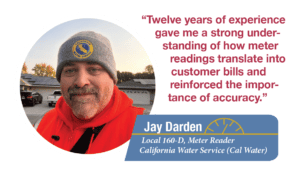
Most days, I start early — especially in the summer, when our shift runs from 6:00 AM to 2:30 PM. That early start helps us beat the Northern California heat, where temperatures can reach 115º. I work in Chico, one of Cal Water’s 23 districts represented by UWUA’s California Water Utility Council.
I’ve been with the company for 12 years, starting in customer service before moving into the field five years ago. That experience gave me a strong understanding of how meter readings translate into customer bills and reinforced the importance of accuracy.
Our work is organized on a rotating cycle system. There are 20 cycles, and each day we’re assigned a different one. The five of us in the Chico district rotate routes monthly so everyone becomes familiar with different parts of the service area. On any given day, I read anywhere from 250 to 400 meters, though the numbers don’t tell the whole story. Rural or difficult-to-access routes can take much longer, even with fewer meters.
A typical day is a mix of driving and walking. I mostly work on my own, parking the truck and walking through neighborhoods. I usually walk seven to 10 miles a day. It’s one of the best parts of the job — being outside, staying active, and getting to know the communities.
We read most of our meters manually. That means opening the meter box, clearing any dirt, and reading the dial directly. Some can be read remotely using an antenna connected to a handheld device, but most still require a hands-on approach.
At the end of the day, we shift into another important responsibility — checking for issues like stuck meters. Sediment buildup can prevent a meter from accurately recording usage. When that happens, we shut off the water, replace the meter, flush the line, and restore service. Because we perform this kind of work, we’re required to hold a Distribution Grade 2 (D2) certification from the State of California, which involves coursework, testing, and continuing education.
We also watch for unusually high usage and leaks. If something looks off, we verify the read and flag it for follow up. It’s all part of making sure the system works properly and customers are billed accurately.
Technology is starting to change the way meter reading is done. Automation will play a bigger role in the future, but there will always be a need for skilled workers to maintain and troubleshoot the system.
For now, I really enjoy what I do. It’s a great mix of independence, physical activity, and problem-solving — and there’s something to be said for getting paid to spend the day outdoors.

I’ve been working in the gas industry for over three decades, and in that time, I’ve seen meter reading change in big ways. What hasn’t changed is the importance of the work — making sure customers are billed accurately and that the system is working as it should.
I cover a large area across western Maryland and southern Pennsylvania, reading over 40,000 meters each month. I drive between 38,000 and 40,000 miles a year in my company vehicle, far more than meter readers in concentrated urban areas. My schedule is mapped out for the entire year, so I know which of 21 routes I’m covering each day.
Mornings start early. I read meters from my vehicle using a handheld AMR radio GPS device that picks up signals from remote transmitters attached to the meters. When a signal doesn’t come through, I get out and check it manually, which is often how I find problems. Older remote meters are beginning to fail, so I’m getting out of the vehicle more than I used to.
Troubleshooting is also part of the job. If a reading doesn’t make sense, I use the same handheld device to check the meter, reprogram equipment, execute any orders and coordinate with service workers when needed. Communication is important when you cover this much territory.
When meters are inside, requiring me to enter the building, I carry a safety device that monitors for carbon monoxide and gas leaks and can signal for help if I need assistance.
Technology has transformed the job over the years. When I started, I walked house to house, often entering customers’ homes to read inside meters. For nearly 18 years, I walked eight to 10 miles a day, and I loved it. I got to know customers and felt connected to the communities I served.
Now I drive all day, and that comes with its own challenges. Cameras in our vehicles record while we’re driving. I understand the safety argument, but being filmed all day takes a toll. We also can’t use hands-free calls anymore, which used to be how I stayed alert on long solo days.
Staffing has changed, too. When I started, the territory had four union meter readers. Today, I’m the only one — contractors and automation handle the rest. AMI meters, which transmit data automatically, are being rolled out now, starting with hard to access meters and larger commercial accounts. The timeline I’ve heard is around 2030 for broader deployment.
I’m reaching retirement age, and after everything that’s changed, I’ll be ready. But I take pride in what I’ve done here. Meter readers are often the first to spot a problem in the system. That responsibility doesn’t go away just because the technology changes. I’ve always taken it seriously, and I always will.