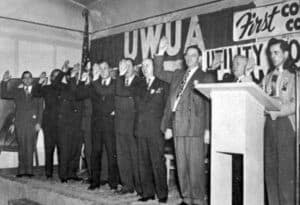
In April 2026, the UWUA marks 80 years since delegates gathered in Atlantic City to adopt the union’s first Constitution. That convention did more than form a national organization — it established a direction rooted in dignity on the job, safety, strong training, and collective voice. Eight decades later, those principles continue to guide the union through an industry landscape defined by technological change, infrastructure investment, workforce transition, and new organizing opportunity.
This anniversary is not only a moment to recognize the past, but to assess how the union’s founding values position it to grow stronger ahead.
From foundation to forward motion
 When the union marked its 75th anniversary in 2021, utility workers were operating through a global pandemic that underscored how essential their work is. Since then, industry change has accelerated. Utilities are modernizing grids and water systems, integrating new energy sources, and deploying advanced technologies under growing regulatory and public scrutiny. Across electric, gas, water, nuclear, and emerging energy sectors, demand for skilled, safety-focused workers continues to grow.
Experience shows a consistent pattern: progress follows preparation. Investment in training, organizing, and member engagement drives adaptation and growth, and helps locals expand their reach while maintaining strong standards.
A three-part timeline published in The Utility Worker during the 75th anniversary traced how organizing, bargaining, and training built today’s standards.
Training as a growth strategy
Training remains one of the union’s most important opportunity areas. Apprenticeship expansion, skills development, mentorship, and peer instruction help workers adapt to new technologies while preserving union standards of safety and craftsmanship.
The Power for America Training Trust continues to grow as a national model for utility workforce development, emphasizing hands-on instruction, safety culture, and job-specific preparation. Its reach is expanding into the water sector, including a registered apprenticeship program launched with California water utilities — an example of how union training evolves alongside industry needs.
Training is increasingly tied to emerging technologies, including digital controls, grid modernization tools, and AI-assisted operations. Expanding union-directed training helps ensure modernization strengthens the workforce while keeping safety and reliability at the center of new systems.
Organizing opportunity across sectors
Since the 75th anniversary, renewed organizing momentum has created new opportunities across public and private utilities and in classifications spanning water, gas, electric, renewable, and professional roles.
The union has revitalized its organizing program with new leadership and dedicated staff, including a national organizing director and two full-time organizers supporting campaigns nationwide. That investment is strengthening local capacity and improving campaign coordination.
Organizing now spans traditional utility employers and newer energy operations, from large facilities to smaller units. Worker interest in representation continues to be driven by the need for voice, enforceable standards, and job protections.
Organizing is more than growth — it builds leverage. Each newly organized unit strengthens bargaining power and reinforces safety and training standards. First-contract gains across multiple states show that organizing and bargaining strength must advance together to deliver lasting results. There is also growing emphasis on regulatory engagement to ensure worker expertise is represented in policy discussions shaping energy and infrastructure systems.
Industry transition means union opportunity
Infrastructure reinvestment and energy transition are reshaping opportunity across UWUA regions. Grid modernization, pipeline replacement, water upgrades, nuclear plant recommissioning, and clean energy integration all require highly trained labor.
Recent industry shifts — including renewed nuclear activity and renewable conversion projects — are not replacing union work but expanding it. These areas depend on strong training, safety practices, and technical mastery.
Adapting early to industry change helps preserve standards and jobs while positioning members to lead in new areas of work.
Preparing the next generation
Workforce retirements are accelerating across utility sectors, increasing the importance of mentorship, steward training, and leadership development. UWUA Young Worker and Women’s Committee programs are expanding mentorship efforts, while local engagement initiatives are strengthening leadership pipelines and participation among newer members.
Union-wide development efforts — including the UWUA Leadership Conference held in May 2025 — reinforced practical training in representation, organizing, and member engagement. The 2026 regional conferences will continue that focus through hands-on education and cross-local strategy sharing.
Carrying the mission forward
The UWUA Constitution adopted in 1946 established a framework built on unity, worker voice, and public service. Eighty years later, that framework remains active through organizing, training, bargaining, and safety standards nationwide.
Anniversaries measure time. Strength is measured in participation.
The union’s future will be shaped by how actively members organize, train, mentor, and stand together at work. Tools and systems will evolve, but the foundation remains the same: collective action, skilled work, and shared responsibility.
Industries will evolve. Technologies will change. But the principle that launched the union still holds: when utility workers stand united, they power both essential services and lasting progress.
———
The Road Ahead
Throughout this year, The Utility Worker will share perspectives from national officers and executive board members on the union’s future and the opportunities ahead. Each was asked to reflect on how the lessons and values that built the UWUA can help guide continued growth and prepare the next generation of utility workers.
The following are the first insights in this ongoing series. Additional perspectives will appear in upcoming issues.
 James Slevin, National President
“In the short term, I look forward to empowering more of our members to build leadership skills at our regional conferences and then eventually seeing these members put those new skills to use and to be more engaged in the UWUA.
The desire to have a voice on the job brought our first members together and that desire still guides us as an organization today. I see the impact a good union job has in the lives of the members I meet and speak with every single day. It is as profound as it is simple and it’s why I’m hopeful about the impact we will make for generations to come.”


Daniel Leary and Craig Connolly, Local 369
“We’ve always succeeded when we have worked together and we will continue to succeed in the face of new challenges, including evolving energy policies, rapid technological advancements, and global economic volatility. Our history shows the value of solidarity and is proof that together we can overcome any obstacle. Our members must embrace current and future technologies to continue to position ourselves to meet the demands of our ever-changing industries. By adhering to our core values of teamwork, solidarity and commitment to professional excellence, we are well positioned to not only meet current challenges but also lead the next generation to great success.”
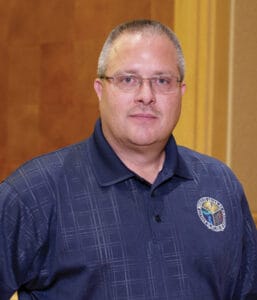 Craig Wright, Michigan State Utility Workers Council (MSUWC)
“We must continue building on our deep industry knowledge and strong contracts. Our future success will also depend on how we respond to rapidly advancing technology, especially AI. Utilities are already using AI and data science in negotiations. We must invest in tools and training for our locals so we stay ahead.”
 Bill Gilbertson, Local 132
“At both the national and local levels, we have more opportunity than ever to organize and strengthen our union’s future. We also need to stay actively engaged in regulatory matters and help shape the narrative from a union-strong perspective. The more members who are willing to stand up and speak out, the stronger we become. Growth and engagement are ultimately a numbers game — and participation is what builds power.”