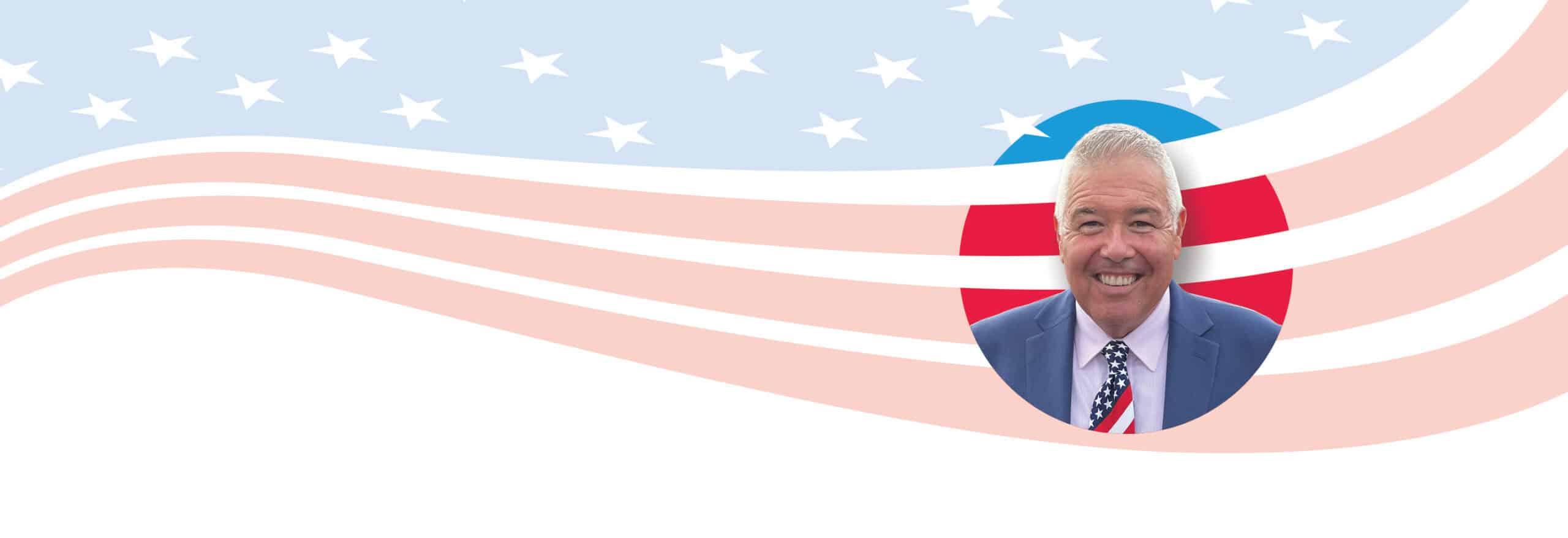
When Mike Molisse talks about public service, he doesn’t separate his years in utility work from his years in government. To him, they’re part of the same path.
“I always felt utility work is public service,” Molisse says. “You’re out there in the neighborhoods every day, in front of people’s homes, dealing with real concerns in real time. That gives you a strong sense of responsibility to the community.”
Molisse, a former UWUA Local 369 member, began his career in 1988 as a meter reader before moving into line work. Decades later, after 25 years on the town council, he now serves as mayor of Weymouth — a coastal community around 30 minutes south of Boston with a city form of government and thousands of working families.
His journey from the field to elected office grew naturally from union values and neighborhood involvement.
Learning the community from the ground up
“I started off as a meter reader for about a year, then moved into the line department,” Molisse explains. “Much of my work was right in Weymouth, where I was raised. You get to know the town that way — street by street, house by house. You understand what people are dealing with.”
While he did not hold a formal union title, union leaders describe him as deeply involved — attending meetings, contributing to bargaining discussions, and working closely with local leadership on safety and contract concerns.
He credits both his union environment and his family’s civic ties for pushing him toward public office. A close family friend and mentor, Bob Ambler — a longtime Local 369 business agent and Massachusetts state representative — showed him how labor values and public service could go hand in hand.
“I was always involved with neighborhood associations and local issues,” Molisse says. “I saw what the town needed and felt like I could help.”
In 2000, while still working full-time at National Grid, he ran for Weymouth Town Council — and won.
Union experience at the council table
Molisse went on to serve 25 years on the Weymouth Town Council, including four years as council president and more than 15 years as Budget Committee chairman. Throughout that time, he says, his union background shaped how he approached decisions.
“Being a utility worker and a union member gives you a real understanding of working people’s needs,” he says. “You understand contracts. You understand negotiations. You understand that management and labor both have responsibilities, and you have to find a path that works.”
That perspective proved especially valuable when dealing with municipal labor agreements and department budgets.
“When you sit on the other side of the table as mayor, it helps to already understand the process,” he says. “You know what goes into a fair agreement and how important it is to respect the workforce.”
Stepping into the mayor’s office
Molisse became mayor in July 2025 after the previous mayor stepped down, moving from his role as council president into the chief executive position. Last November, he ran to fill the seat and was elected unopposed — a rare outcome in a politically balanced community.
Local labor leaders say that result reflects broad trust built over decades.
Today, Molisse oversees multiple departments and major development efforts, including infrastructure upgrades tied to the redevelopment of the former South Weymouth Naval Air Station site — now known as Union Point. Through his statehouse relationships, the town secured tens of millions of dollars in infrastructure funding to support future growth there.
A message to union members
Molisse believes more union members should consider local office — not just voting, but serving.
“Union members shouldn’t underestimate what they bring to the table,” he says. “We deal with budgets, safety, logistics, and public accountability — all of that carries over into government.”
He also stresses that political engagement doesn’t have to start with running for mayor.
“Go to meetings. Join boards. Get involved in your local commissions and your neighborhood. That’s how it starts,” he says. “Local government affects your schools, your roads, your utilities, your taxes — everything close to home.”
For Molisse, the connection is simple and lasting: “The union taught me solidarity, fairness, and responsibility to others. That’s exactly what public service is supposed to be.”