
Nuclear energy can power entire cities, yet discussions about it have long been clouded by political hesitation and public mistrust. Now, that narrative is changing.
Across the United States, shuttered reactors are being restarted, plant licenses extended, and new designs proposed. Policymakers and tech companies alike are turning to nuclear power as the only carbon-free source that can reliably meet the nation’s surging appetite for electricity.
It’s what many are calling a nuclear renaissance. But for the UWUA, the story isn’t about megawatts or megatrends — it’s about people. The men and women who have always run America’s nuclear fleet remain the foundation of this new energy era, and they’re more in demand than ever.
A perfect storm of demand
A decade ago, the idea of new nuclear power in the United States sounded like wishful thinking. Today, surging demand is rewriting the rules. The reality of data centers being used to power resource-intense industries like artificial intelligence, cryptocurrency, and cloud computing — coupled with the electrification of vehicles and manufacturing — has driven a dramatic spike in energy use.
The U.S. Energy Information Administration projects that AI-related power use could double national electricity demand by 2030. With more than 4,000 data centers already operating and “AI factories” consuming hundreds of megawatts apiece, tech companies are hunting for dependable, carbon-free power.
“Nuclear is the only zero-carbon source that can run 24/7,” says Jim Harrison, UWUA’s Director of Renewable Energies. “Across both sides of the political aisle, people are starting to see nuclear differently. The technology has advanced, and the safety record is strong. But this renaissance has to be done right — with strong worker protections and an independent Nuclear Regulatory Commission.”
From policy to practice
Federal and state policies have shifted sharply. The bipartisan ADVANCE Act, signed in June 2024, streamlines permitting for next-generation reactors while maintaining safety oversight. Several states — including Illinois, West Virginia, and Minnesota — have lifted long-standing bans on new nuclear construction.
In October, the Department of Energy announced a $1 billion partnership with Advanced Micro Devices to build two supercomputers aimed at accelerating development of advanced reactors, batteries, and grid-modernization tools. One system, Lux, will triple current AI computing capacity at Oak Ridge National Laboratory and could shrink project design timelines “from years to months,” according to Energy Secretary Chris Wright.
Harrison, who serves on DOE’s Workforce Advisory Board, says these initiatives are promising — but they must center on the people who make nuclear work. “Out of the whole board, there are only two labor representatives,” he notes. “It’s critical that UWUA be there to make sure workers’ interests are part of the conversation as nuclear energy expands.”
 Catching up — and building smarter
The challenge is steep. According to The New York Times, China has nearly as many reactors under construction as the rest of the world combined, while the United States has built only two since 2013. Even reactivating an existing facility can take five years.
But Harrison points to new tools that could level the field. Small modular and advanced reactors (SMRs and ANRs) use standardized designs and factory-built components, promising faster and safer deployment. “Standardization is key,” he says. “It keeps costs in check and gives workers consistent training platforms. However, cutting red tape is not the same as lowering the bar.”
Michigan’s milestone: Palisades reborn
Nowhere is the new momentum clearer than at Palisades in southwest Michigan — the first decommissioned U.S. nuclear plant slated to restart. When it closed in 2022, the plant seemed finished. Two years later, under new ownership by Holtec International and with federal loan guarantees supported by the Biden administration, strong backing from Michigan Governor Whitmer, and advocacy by the UWUA, it’s being brought back to life.
“You can’t just walk in from another plant and start running Palisades,” says UWUA Local 150 President Aurbery Watson. “Even experienced nuclear workers have to go through 18 months of plant-specific training before they’re qualified. That’s how we keep standards high and safety first.”
Veterans who had retired after 30 years have returned to train new recruits. “They’re leading the qualification programs and mentoring the next generation,” Watson says. “Who better to do that?”
Michigan State Utility Workers Council President Craig Wright calls the project proof of concept: “Palisades shows what the nuclear renaissance can look like — turning a decommissioned plant back into a fully operating, clean-energy powerhouse. If we can do it here, other closed plants can follow.”
Indian Point: a case for revival
Few closures hit as hard as Indian Point in New York, which shut down in 2021, taking 400 union jobs and a major source of reliable power with it. Local 1-2 President Frank Morales wants it revived.
“The waste is still on site, so the land can’t be used for anything else,” he says. “With new technology and strict safety standards, Indian Point could be a win-win for New York. It’s green, it could provide tremendous capacity, and it’s safe.”
Holtec, which also owns Indian Point, estimates a restart would take four years and roughly $10 billion. Morales believes it’s worth the fight: “When it closed, an entire town lost its economic engine and New York City lost its source of reliable, inexpensive power. It’s time to see nuclear not as the problem, but as part of the solution.”
Workforce at a crossroads
Even as plants extend licenses, the nuclear workforce faces an urgent reality: it’s aging faster than it’s replenishing. Many operators are nearing retirement, and it can take 18 months to qualify a new one.
“The nuclear renaissance can’t happen without people — skilled, union-trained people,” Harrison says. “That’s the foundation.”
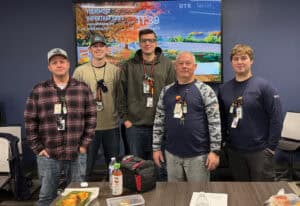
His DOE board is pushing for regional training hubs, fast-track programs for Navy veterans, and expanded simulator capacity to speed certification. “No workforce, no renaissance” has become a mantra.
In Michigan, Local 223 Fermi Division Vice Chair Nick Major explains the high stakes. “It can take months just to fill a class of 10 new operators,” he says. “But we can’t lower the bar. This is serious work — one mistake can affect a community, a nation, even multiple nations.”
Major adds that utilities must treat training as investment, not expense. “They spend over a year and a half licensing an operator. If we want nuclear to grow, we need committed people who plan to make a career of it.”
Ohio’s steady core
In Ohio, Local 270 President Chris Ericksen describes the Perry Plant as a model of quiet endurance. “There’s definitely a renewed appetite for nuclear,” he says. “The plant just got a 20-year license extension, and they’re already working on the next one.”
That longevity matters to communities that depend on stable jobs and tax bases. “Our members are proud to provide power that keeps the lights on and the grid balanced,” Ericksen says. “When you talk about reliability, you’re talking about union labor.”
Blue skies at Seabrook
In the Northeast, Local 555 President Kevin Schoff notes a dramatic shift in tone at Seabrook Station in New Hampshire. “Five years ago, there was a dark cloud over nuclear power. Now we’re seeing blue sky through the clouds.”
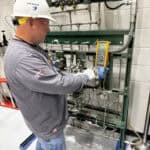
Seabrook’s 1,250-megawatt reactor is seeking another 20-year license extension. Rumors abound that a major tech company — possibly Microsoft or Google — is eyeing adjacent land for a data center. Because Seabrook’s output is already committed to the grid, such a project could trigger a power uprate through turbine upgrades.
“The renewed interest in nuclear is giving younger workers a sense of longevity,” Schoff says. “We used to lose people because they weren’t sure nuclear would be around. That’s changed.”
Safety, standards, and union strength
Whether at Palisades, Fermi, Perry, or Seabrook, UWUA members emphasize one constant: no shortcuts.
“Our members are on top of every condition report that comes out,” says Watson. “If they see something off, they speak up — not to cause trouble, but to protect everyone on site. That’s what union-trained safety culture looks like.”
Harrison warns that while policymakers talk of “streamlining,” some proposals go too far — such as efforts to raise allowable radiation exposure limits. “You can’t rebuild the industry by cutting corners,” he says. “Progress means safer plants, not looser rules.”
Reviving the fuel cycle
Another often-overlooked piece of the puzzle is domestic nuclear-fuel production. “The United States hasn’t had a robust uranium-enrichment program since the 1990s,” Harrison explains. “Bringing that supply chain home is an opportunity to create new union jobs in a strategic industry.”
DOE’s new AI-driven supercomputing initiative could accelerate that effort by modeling enrichment processes and reactor components in months rather than years. For unions, it represents both an industrial policy and a workforce-development opportunity.
Public confidence and education
Decades of misunderstanding have left nuclear power fighting an image problem. “We failed to educate the public on how safe these plants really are,” says Schoff. “We let the naysayers dominate the discussion, and they won. Now it’s our job to tell the story right.”
In New York, Morales plans a public-education campaign to help policymakers and residents see nuclear as part of a just transition. “Governor Hochul is taking a new look at nuclear because renewables alone can’t meet the state’s carbon-free goals,” he says. “Our job as a union is to make sure that future includes good, safe, union jobs.”
From slogan to strategy
If the 20th-century nuclear era was defined by engineering ambition, the 21st must be defined by resilience — pairing innovation with safety, and technology with respect for labor.
As Harrison puts it: “When DOE or NRC talk about workforce development, that’s really code for union development. It’s about making sure the people who understand these systems are part of the planning, not just the execution.”
Technology evolves quickly, but union values of safety, solidarity, and skill remain timeless. The coming decade will test whether America can match its clean-energy ambitions with investment in the people who keep the reactors humming.
“We can’t meet our climate goals without a robust nuclear industry,” Harrison says. “But we also can’t do it without protecting the people who make that industry possible.”