This fall has been a busy and important time for safety in our union. Two major developments stand out — our national safety committee training at Power for America (P4A) in September and our union’s active engagement in federal safety rulemaking. Together, they reflect the UWUA’s mission to empower our members through education, advocacy, and a strong collective voice for safer workplaces.
Training the trainers: preparing for regional safety leadership
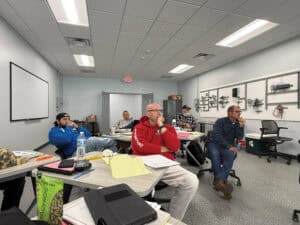
 In September, we held a three-day “train-the-trainer” session at the Power for America Training Trust (P4A) in Michigan. This program was designed to prepare our UWUA National Safety Committee members to lead workshops on safety leadership and negotiating for safety.
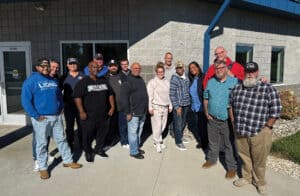
The goal was to ensure every region has local leaders equipped to deliver effective, hands-on safety training. Fifteen safety committee members from across our regions participated, representing the water, gas, and electric divisions. Each attendee completed an intensive program on how to facilitate workshops, engage members, and structure classroom discussions. P4A Executive Director Jonathan Harmon co-facilitated the sessions, walking participants through best practices for teaching adult learners and setting up interactive, problem-solving environments. 
On day two, the group focused on safety leadership — how to model safe behaviors, strengthen committee effectiveness, and build safety culture through accountability and communication. Day three focused on negotiating for safety, emphasizing how locals can strengthen contractual language to protect members when regulatory enforcement falls short. As I often tell members, when OSHA retreats, we have to advocate through our contracts. These topics aim to help locals do just that — bargain strong safety provisions, establish effective joint safety committees, and fully utilize P4A resources for training and follow-up.
This will help expand our training capacity but also build lasting local resources. For example, if a local wants a deeper dive into one of these topics, they’ll have qualified trainers nearby who can deliver it. That’s how we build sustainable safety leadership from the ground up.
Standing up for safety: UWUA’s voice in federal rulemaking
At the same time, the UWUA has been active on the national stage, submitting detailed comments to the Federal Register on four major OSHA rulemakings — asbestos, lead, the General Duty Clause, and heat illness prevention.
 In our comments, we strongly opposed proposed changes that would weaken existing protections for asbestos and lead exposure. OSHA’s proposals would allow less stringent respirator requirements and reduce medical evaluations — moves that could put workers at greater risk of disease. We made it clear that relaxing substance-specific protections for deadly hazards like asbestos and lead is unacceptable.
We also opposed changes to the General Duty Clause that would limit OSHA’s ability to enforce safety in “inherently risky” industries. For utility workers — who often face hazards that fall outside existing standards — this clause is a critical enforcement tool. Weakening it would take away one of the few avenues for holding employers accountable when no specific rule applies
Finally, we supported OSHA’s proposed Heat Injury and Illness Prevention standard. Our members work long hours outdoors
and in high-heat environments, from boiler rooms to storm restoration sites. Climate change is making heat exposure a year-round threat. We urged OSHA to move quickly on this lifesaving rule, emphasizing mandatory rest, shade, hydration, and acclimatization requirements.
Moving forward
The UWUA’s safety work is about more than compliance — it’s about empowerment. Whether it’s building the next generationof safety trainers or fighting for stronger national protections, we’re committed to ensuring that every member goes home safe at the end of the day. I want to thank all the safety committee members who joined us at P4A and everyone who continues to speak up for safety in their locals. Together, we’re not just responding to hazards — we’re shaping a safer future for every UWUA member.