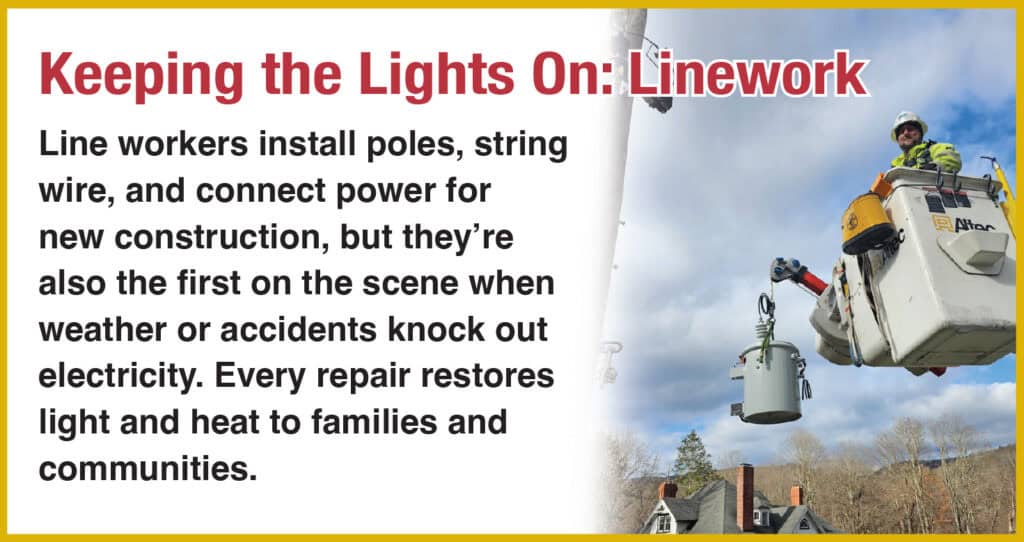
 “Line workers install poles, string wire, and connect power for new construction, but they’re also the first on the scene when weather or accidents knock out electricity. Every repair restores light and heat to families and communities.”
Electric line workers are the backbone of the nation’s electrical grid — the people who build, maintain, and repair the systems that keep homes, hospitals, and businesses running. Their work begins long before the flip of a switch and continues through every storm and outage that follows.
Line workers install poles, string wire, and  connect power for new construction, but they’re also the first on the scene when weather or accidents knock out electricity. The job is physically demanding and often dangerous, involving high-voltage lines, heavy equipment, and long hours in every kind of weather. It’s not unusual for them to work suspended in bucket trucks or climb poles 50 feet in the air to make a repair. It requires deep technical knowledge, strong teamwork, and an unshakable commitment to safety.
For most, the appeal lies in the challenge — and the purpose. Every repair restores light and heat to families and communities. As these stories show, whether climbing poles, testing meters, or leading crews, members like Bob German, Mike Smith, and Frank Hawk embody the pride, skill, and endurance that define the UWUA.
Frank Hawk
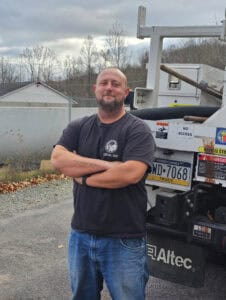 UGI Utilities
First Class Lineman
Local 262
I’ve been a lineman for 20 years now, and I can’t imagine doing anything else. I got my start with the IBEW in northeast Pennsylvania when I was 20 and joined UWUA Local 262 in 2013 as a first-class lineman with UGI Utilities. In April 2024, I was elected president of our local, which represents 41 members — 10 at the Hunlock Power Station and 31 on the electric distribution side at UGI, including 11 linemen, meter techs, and substation employees.
Before I ever climbed a pole, I was an electrician. Right out of high school, I thought that would be my career, but after a few months working indoors, I realized I needed to be outside. Around that time, the local fire department where I volunteered hosted training for IBEW apprentices, so I got to know a lot of the guys in the trade. The more I learned, the more it appealed to me — the mix of physical work, technical skill, and teamwork it takes to keep the power flowing. I entered a 7,000-hour apprenticeship with the IBEW, combining on-the-job training with classroom lessons and periodic tests. When I topped out, I was recognized as a journeyman lineman — or, under our UGI contract, a first-class lineman.
Our crew covers about 75,000 customers in Luzerne County, plus part of Wyoming County. My wife and I live in Larksville, which is part of our territory.
We handle everything from new service installations to troubleshooting outages for residential, commercial, and industrial customers. Most of our system is overhead, but we do a fair amount of underground work, too. A typical day might mean setting poles, running wire, or installing transformers. If it’s part of UGI’s distribution system, we handle it.
Our standard hours are 7:30 a.m. to 4 p.m., Monday through Friday — though “standard” doesn’t mean much in this job. We’re on call 24/7, and when a storm hits or a line goes down, we go. On average, our 11 linemen respond to about 30 calls a week — two or three apiece — and we each log around 1,200 hours of overtime a year. Nights, weekends, holidays — the lights don’t wait.
We don’t have take-home trucks, which I’ve been trying to change. Instead, we report to one central location, grab our vehicles, and head out to wherever the trouble is. Most days we work in two-person crews, but for after-hours emergencies, you’re often alone unless the job calls for backup.
Even with all the new technology, the fundamentals haven’t changed. We still climb when we need to, though the younger guys do most of it now. Every year we recertify in first aid, CPR, AED, and rescue — including pole-top and bucket rescue — so we know we can save our partner if something goes wrong, and they can save us.
It’s demanding work, but it’s rewarding. Even after two decades, I take pride in being part of a trade that values skill, safety, and service. Serving as local president has added another layer of purpose. Our members work hard and deserve a strong voice. Whether it’s negotiating fair contracts or pushing for better equipment, I take that seriously. Linework isn’t just a job — it’s a commitment to each other and to the communities we serve.
Bob German
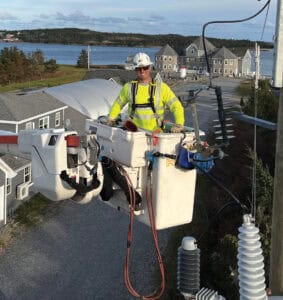 United Illuminating
Journeyman Lineman
Local 470-1
I’ve been a journeyman lineman for nearly a decade, and I can honestly say there’s no other job like it. Every day is different — the hours, the conditions, the challenges — but that’s exactly what I love about this trade.
I started out as a licensed electrician. I’d been doing electrical work since I was 16, working for small contractors on everything from homes to large commercial projects. My dad was a lineman, so I grew up around the trade. After completing my apprenticeship as an electrician, I spent a few years in that line of work before deciding it was time to follow in his footsteps. I applied to line school — and never looked back.
Getting into the trade isn’t easy — it’s competitive, and the apprenticeship is demanding. Ours takes about four years. You start off in a five-week boot camp, building everything by hand with no power tools — just like they did decades ago. It’s designed to see if you have what it takes: the mechanical skills, the strength, and the stomach for heights and long hours. Not everyone makes it through.
These days, I work a regular shift from 7 a.m. to 3:30 p.m., Monday through Friday — though “regular” is a loose term in this job. We handle everything from reconducting projects, where we replace poles, wires, and transformers along entire streets without interrupting power, to installing new services for homes and businesses. We do both overhead and some underground work, though I mostly focus on overhead distribution. Every pole, wire, and piece of equipment we touch is energized, so safety comes first.
Every morning starts with a tailboard meeting, where we go over the job and the plan. But plans change fast. What looks simple on paper can turn complicated once you’re up in the air. That’s where experience and teamwork come in. I’ve worked with my partner, Jake Holly, for five years now. Some days we’re joined by another journeyman or an apprentice; it’s always a crew effort.
There’s a lot of physical work — setting poles, framing them, moving lines, installing switches and transformers — all while keeping power flowing to the customers below. We often rebuild or raise poles for new infrastructure, like traffic lights or larger developments. You’d be surprised how much happens above your head that you never notice.
Outside of regular hours, we handle storm duty and trouble calls. We’re a relatively small group — around 100 linemen covering 17 towns along Connecticut’s southern coast — so when bad weather hits, the calls don’t stop. I’ve worked through hurricanes, snowstorms, and even went to Nova Scotia after Hurricane Fiona. Mutual aid trips like that remind you how essential this work is — we’re the ones getting the lights back on.
The job is rewarding, but it takes a toll. Long nights, missed family time, and constant readiness — it’s not easy. I’ve been married 11 years and have three kids. Balancing that with this type of work is its own challenge, but there’s a pride that comes with what we do. We build and maintain the system that keeps our communities running.
At the end of the day, being a lineman isn’t just a job; it’s a way of life. You’ve got to love the work, the people, and the challenge. For me, there’s nothing better than driving past a stretch of line and knowing I helped build it — safely, skillfully, and with the lights still on.
Michael Smith
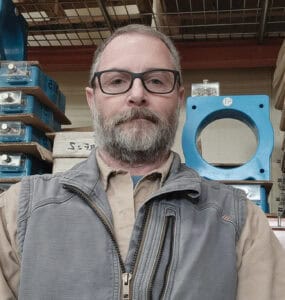 Pacific Power
District Meterman
Local 197
My coworkers like to say I’m kind of a unicorn in the trades — I hold three journeyman cards: lineman, estimator, and meterman. My first journeyman job was as a lineman, and I did that work for a little over 16 years with two utilities.
I started out at Pacific Gas and Electric in California, first as a miscellaneous equipment operator in the Fresno area. I completed my three-year lineman apprenticeship there, working in what they called “general construction” — the crews that handled the big jobs and traveled wherever they were needed. After that, I joined Pacific Power, a division of PacifiCorp, in 2001 and have been there ever since.
Line work is tough. It’s demanding, physical, and it takes a toll over time. By the time you hit your 50s or 60s, the mileage catches up — shoulders, backs, knees — you name it. I had more than my share of shoulder problems, and after four shoulder surgeries and a back fusion, I finally had to give it up. Years of climbing poles, carrying gear, and working in all conditions just wore me down.
When it was time to make a change, I moved into an estimator role — essentially shifting from the field to the office. For seven years I helped customers plan their electric service: designing power systems, arranging rights-of-way, and managing contracts. It was a different kind of challenge. After more than two decades outdoors, I had to learn computer systems and new technology that had evolved far beyond what I’d last studied in community college. It was an adjustment, but I enjoyed learning the other side of the business.
In 2018, I transitioned again — this time into metering — and earned my journeyman meterman card. Now I work out of Oregon’s southwest coast, covering Coos County and surrounding areas. My shift runs Monday through Friday, 7 a.m.to 3:30 p.m., and I have my own truck equipped with portable testing gear. I work alone about 95% of the time, installing all types of new meters, replacing faulty ones, wiring and installing current transformers for instrument rated metering set ups, and performing accuracy tests on existing metering equipment.
A large part of my job is ensuring meters work properly so we’re not overbilling or underbilling customers. Each year, we’re required to test a certain percentage of meters, and the larger the customer, the more often we test. A residential meter might not be checked again for 10 years, while an industrial customer — like a sawmill or factory using a million dollars’ worth of electricity a year — gets tested much more frequently.
The newer meters are sophisticated — basically small computers with cell modems that communicate usage data directly to the company. They’re a far cry from the old analog meters that we used to read in person monthly. Technology has changed dramatically in my 30 years in the industry, but the fundamentals — accuracy, safety, and service — remain the same.
Looking back, I never planned to have three careers within the same company, but that’s how it worked out. I started in the field because I wanted security. I grew up around loggers, mill workers, and self-employed tradesmen — people who worked hard but didn’t have a retirement or benefits. Then I saw one relative who was a lineman. He had steady work, a pension, and could actually take a vacation. That stuck with me. Early on, I had also spent five years with the U.S. Forest Service as a wildland firefighter. That experience taught me the value of hard, physical work, but also made me realize that if I was going to work that hard and take those kinds of risks, I wanted a career that offered real stability and rewards.
I’ve been married for many years, with four kids — my oldest is 32, my youngest 18. I’ve had a good career — from the line to the meter — and even with the scars, I wouldn’t trade it for anything.